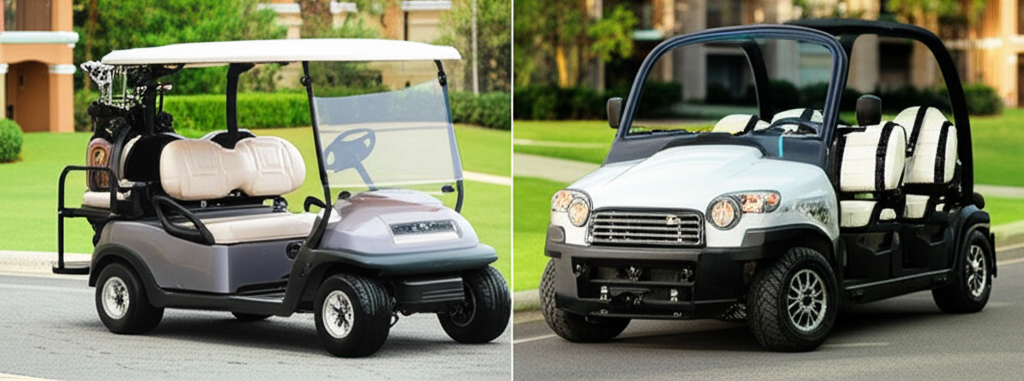
Most rental vendors in beach communities already rent street-legal vehicles — LSVs or carts equipped with required safety gear like headlights, taillights, turn signals, and seatbelts. Here's what the distinction means and why it matters for your trip.
| Feature | Standard Cart | Street-Legal Cart (LSV) |
|---|---|---|
| Max Speed | Up to 20 mph | Up to 25 mph |
| Street Legal | Varies — some communities allow on designated routes | Yes, on roads posted 35 mph or less (varies by state) |
| Requires License | Not required on private property; varies on designated paths | Valid driver's license required in most states |
| Insurance Required | Usually included by the vendor or available as add-on | Required in most states for on-road use — typically handled by the vendor |
| VIN / Title | Not required | Required — federally regulated vehicle class |
| Safety Equipment | Minimal — windshield and seatbelts optional depending on jurisdiction | Headlights, taillights, mirrors, seat belts, horn required |
| Typical Use | Resort areas, beach communities, neighborhoods with cart paths | Anywhere a golf cart goes, plus low-speed public roads |
| Rental Cost Range | Most vendors rent street-legal carts at standard rental rates. A separate "LSV premium" is uncommon — it's baked into the fleet. | |
What to Expect from Your Rental
Beach towns (Gulf Shores, Orange Beach, Port Aransas)
Most vendors in these markets rent street-legal carts. You'll get headlights, taillights, turn signals, and seatbelts standard. No need to specifically request an LSV — it's what you're already getting. Browse vendors in Orange Beach, AL or Port Aransas, TX to see what's available.
Resort or private communities
Some rentals are for on-property use only (e.g., resort grounds or gated communities). These may be standard carts without street-legal equipment. Check with your vendor about where you can drive before booking.
Planning to cross major roads
If your route includes state highways or roads above 35 mph, a cart — even an LSV — won't be legal there. Plan your route using local rules. Check our where you can drive a golf cart guide for a breakdown by state and common beach town rules.
Frequently Asked Questions
Can you drive a golf cart on the road?
It depends on local laws, but most rental carts in beach communities are already street-legal vehicles equipped with headlights, taillights, turn signals, and seatbelts. These meet LSV requirements and can operate on roads posted at 35 mph or less. Always check local ordinances for specific route restrictions.
Is an LSV the same as a golf cart?
No. LSVs (low-speed vehicles) are a federally defined vehicle class capable of speeds up to 25 mph, with required safety equipment including headlights, taillights, mirrors, seat belts, and a VIN. Golf carts are slower, simpler vehicles not designed for public road use.
Do you need a license to drive an LSV?
In most states, yes — a valid driver's license is required to operate an LSV on public roads. Requirements vary by state. Golf carts operated on private property or designated cart paths typically do not require a license.
Which is better for a beach vacation — golf cart or LSV?
Most beach rental vendors already provide street-legal carts. You don't typically need to choose — the vendor's fleet determines what you get. Focus on cart size (4 vs 6 vs 8 seater) and rental duration instead.